Definition: A link acquisition strategy leveraging public relations tactics to earn editorial backlinks from news sites, journalists, and authoritative publications. Unlike traditional link building, digital PR focuses on creating newsworthy content—data studies, surveys, expert commentary—that naturally attracts links from high-DR domains.
🎯 Primary Goal Editorial Backlinks
⚡ Key Mechanism Newsworthy Content
🏗️ Target Authority DR 70-90+
⏱️ Time to Impact 2-8 Weeks
📊 Digital PR vs Traditional Link Building
| Attribute | Digital PR Link Building | Traditional Link Building |
| 🎯 Primary goal | Earned media coverage with links | Direct link acquisition |
| 📰 Link sources | News sites, journalists, publications | Blogs, directories, resource pages |
| 📈 Average DR | 70-90+ | 30-60 |
| ⏱️ Timeline | 2-8 weeks per campaign | Days to weeks |
| 💰 Investment | Higher (content creation, outreach) | Lower to moderate |
| 🔗 Link type | Editorial, contextual | Various (guest posts, mentions) |
| 📊 Scalability | Campaign-based, burst traffic | Steady, incremental |
| ✅ Best for | Brand authority, high-competition keywords | Consistent link velocity |
In 2026, digital PR has become the gold standard for acquiring authoritative backlinks. As Google’s algorithms increasingly value editorial signals and E-E-A-T, links from news publications carry disproportionate weight compared to traditional link building tactics.
🎯 The Digital PR Advantage: Authority Signal Amplification
Digital PR doesn’t just build links—it builds Digital Brand Authority across all three pillars:
- Equity Signals — High-DR editorial backlinks (DR 70-90+)
- Trust Signals — Brand mentions in authoritative contexts
- AI Signals — Presence in news corpora that train LLMs
A single successful digital PR campaign can generate more authority impact than months of traditional link building.

TL;DR: Digital PR Link Building Quick Reference
- Digital PR = Earning editorial backlinks through newsworthy content and journalist outreach
- Core tactics = Data studies, surveys, expert commentary, newsjacking, reactive PR
- Link quality = DR 70-90+ from news sites, industry publications, mainstream media
- Success metrics = Links earned, DR of linking domains, referral traffic, brand mentions
- Timeline = 2-8 weeks per campaign, with ongoing relationship building
- For link health monitoring and competitor analysis: Link Laboratory
- For brand intelligence and media monitoring: SearchAtlas
What Is Digital PR Link Building
Digital PR link building combines traditional public relations with SEO objectives. Instead of measuring success by impressions or brand awareness alone, digital PR specifically targets backlink acquisition from authoritative publications.
⏳ Evolution of Link Acquisition Algorithms
- 2012
Penguin Update: Google penalizes spammy link networks. The shift from “Quantity” to “Quality” begins. - 2016
Penguin 4.0: Link devaluation becomes real-time. “Digital PR” emerges as a safe hat strategy. - 2023
Helpful Content Update & E-E-A-T: Google prioritizes “Experience.” Authoritative news mentions become critical trust signals. - 2026
LLM & Generative Engine Optimization: Brand mentions in news corpora become essential for inclusion in AI Overviews.
The Digital PR Framework
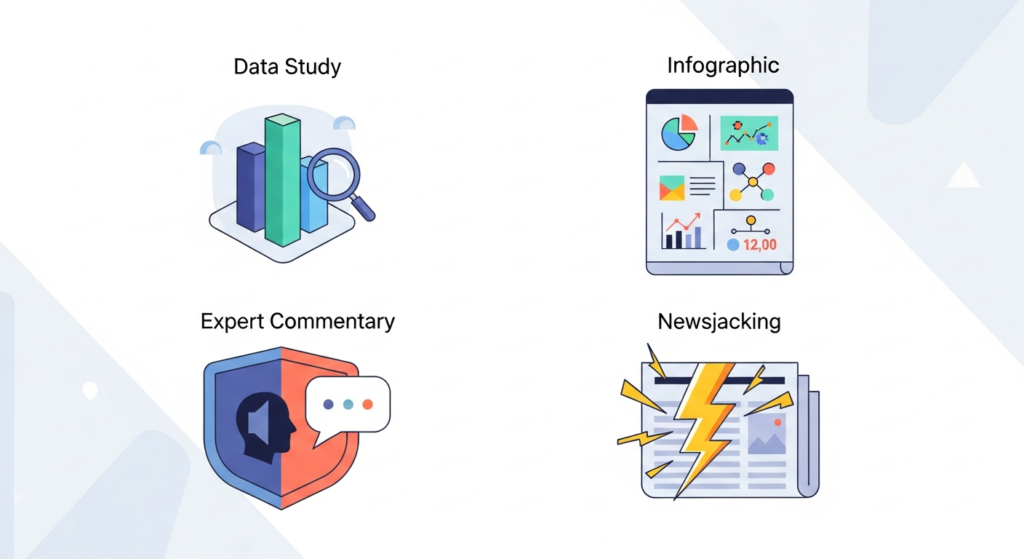
Operational Workflow
- 01
Input Phase: Content Creation
Creation of Data Studies, Surveys, Expert Quotes, and Visual Assets.
Investment Required: High ($2,000-10,000+) - 02
Process Phase: Journalist Outreach
Execution of Media List Building, Beat Research, and Personalized Pitching.
Time Investment: 2-4 weeks active outreach - 03
Output Phase: Editorial Coverage
Acquisition of DR 70+ Editorial Links, Brand Citations, and Referral Traffic.
Expected Results: 5-50+ links per campaign
Digital PR vs Content Marketing vs Link Building
| Approach | Content Type | Distribution | Link Outcome |
| Digital PR | Data studies, news angles | Journalist outreach | Editorial links (earned) |
| Content Marketing | Blog posts, guides, videos | Organic/social/paid | Natural links (hoped for) |
| Traditional Link Building | Guest posts, resources | Direct webmaster outreach | Placed links (negotiated) |
⚠️ Digital PR Is Not…
- Press release distribution — Syndicated press releases rarely earn quality links
- Paid placements — Advertorials with “sponsored” tags provide no SEO value
- Generic outreach — Mass-emailing journalists with non-newsworthy content
- Brand announcements — Company news without broader relevance
Digital PR succeeds when you provide genuine value to journalists and their audiences.
Link Equity Referral Traffic Anchor Text Diversity Syndication Networks DoFollow vs NoFollow Journalist Beat.
Why Digital PR Works for SEO in 2026
The Authority Signal Hierarchy
Google’s algorithms weight links differently based on source authority. Digital PR targets the top of this hierarchy:
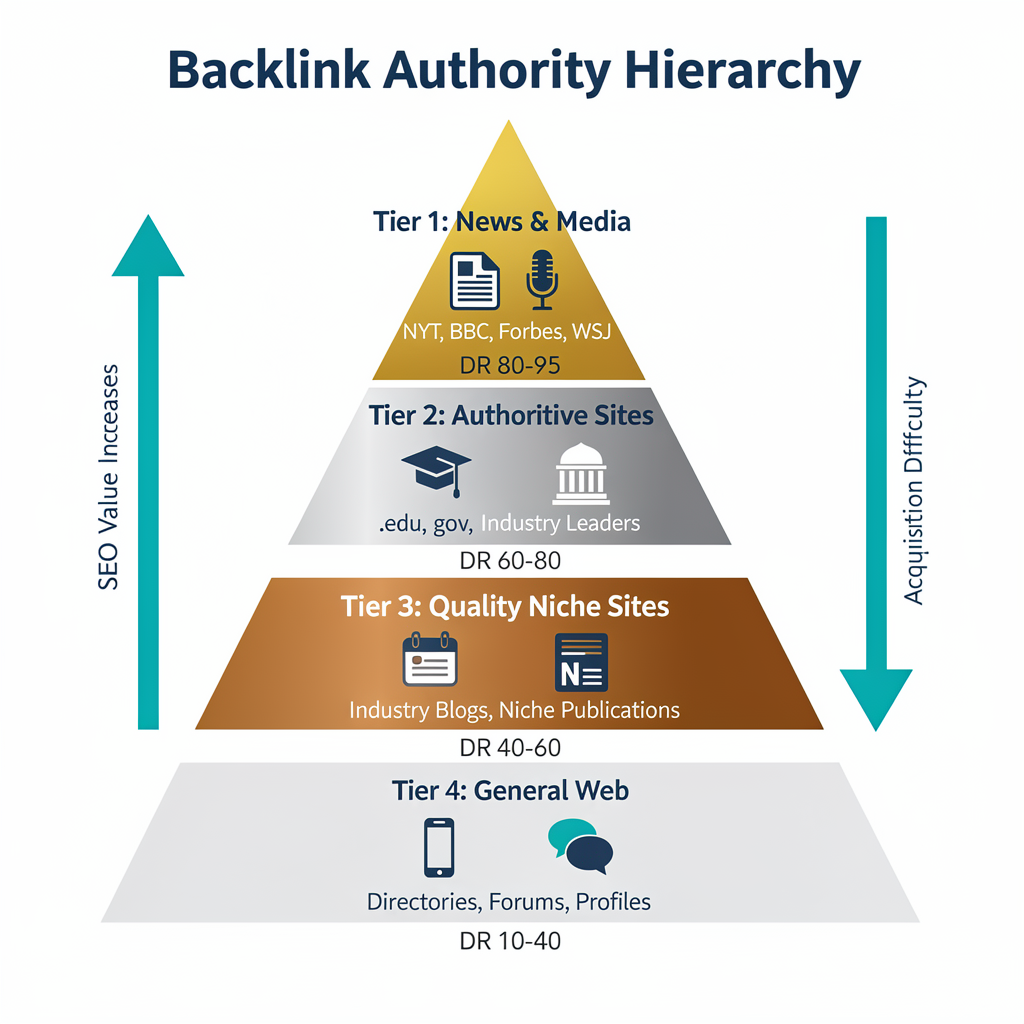
🔗 Backlink Authority Tiers
🏆 Tier 1: The Gold Standard — DIGITAL PR TARGET
Sources: News & Media (NYT, BBC, Forbes, WSJ, Industry Trade Publications) Authority: DR 80-95 Link Type: Editorial Links
🥈 Tier 2: Authoritative Sites
Sources: .edu, .gov, Major Industry Sites Authority: DR 60-80 Link Type: Resource/Citation Links
🥉 Tier 3: Quality Niche Sites
Sources: Industry Blogs, Niche Publications Authority: DR 40-60 Link Type: Guest Posts, Mentions
⚠️ Tier 4: General Web (Limited Value)
Sources: Directories, Forums, Social Profiles Authority: DR 10-40 Link Type: Limited SEO Value
Five Reasons Digital PR Dominates in 2026
| Factor | Why It Matters |
| E-E-A-T Amplification | News citations signal Experience, Expertise, Authoritativeness, and Trust |
| AI Training Influence | News content heavily weights LLM training data → AI Overview presence |
| Link Quality > Quantity | One DR 85 editorial link > 50 DR 30 guest post links |
| Brand Search Lift | News coverage increases branded queries → positive ranking signal |
| Competitor Differentiation | Most competitors can’t replicate news coverage |
💡 The Compound Effect of Digital PR
A successful digital PR campaign creates a compound authority effect:
- Immediate: High-DR backlink + brand mention + referral traffic
- Short-term: Secondary coverage (sites linking to the original story)
- Medium-term: Brand search volume increase + E-E-A-T signals
- Long-term: LLM training corpus presence + AI recommendation potential
This multi-layered impact is why digital PR delivers outsized ROI compared to traditional link building.
⚖️ The Risks & Challenges of Digital PR
While effective, Digital PR carries specific operational risks that must be managed to ensure ROI.
💸 High Capital Risk
Unlike guest posting (pay-per-link), Digital PR requires upfront investment in data and content without guaranteed placement.
Mitigation: Validate angles with journalists before full production.
📉 Negative Sentiment Coverage
Data studies can sometimes yield findings that journalists spin negatively against your industry or brand narrative.
Mitigation: Stress-test data findings for negative angles during analysis.
⏳ Temporal Decay
News-cycle links (Newsjacking) often have high initial velocity but lower long-term relevance compared to evergreen resources.
Mitigation: Balance reactive PR with evergreen data studies.
Digital PR Link Building Strategies
Strategy Overview Matrix
| Strategy | Effort Level | Link Potential | Best For |
| Data Studies | High | Very High (5-50+ links) | B2B, SaaS, finance |
| Surveys & Research | Medium-High | High (10-30+ links) | Consumer, trends |
| Newsjacking | Low-Medium | Medium (2-10 links) | Rapid response capability |
| Expert Commentary | Low | Medium (1-5 links per placement) | Thought leadership |
| Reactive PR (HARO) | Low | Low-Medium (1-3 links) | Consistent link velocity |
| Product/Tool Launch | High | Variable | Unique, newsworthy tools |
Data-Driven Content Campaigns
Data studies are the highest-ROI digital PR tactic because journalists need data to support their stories. Original research positions your brand as a primary source.
Anatomy of a Successful Data Study
🧪 Campaign Blueprint: Data Study
Required Ingredients
- ✅ Proprietary Data (platform analytics, customer data) OR Survey Data (1,000+ respondents for credibility)
- ✅ 3-5 Key Findings (Headline-worthy statistics that challenge assumptions)
- ✅ Visual Assets (Infographics, charts, interactive visualizations)
- ✅ Landing Page (Full methodology, embed codes, media contact)
Execution Steps
- Hypothesis: Identify a counter-intuitive trend or challenge common assumptions
- Collection: Gather proprietary, survey, or public data (triangulate sources)
- Analysis: Extract 3-5 headline-worthy findings with YoY comparisons
- Visualization: Create shareable infographics and embeddable charts
- Packaging: Build dedicated landing page with full methodology
Investment Required: High ($3,000-15,000) Expected Links: 15-50+ Timeline: 4-8 weeks
Data Study Topic Selection Framework
The best data study topics sit at the intersection of three circles:
| Circle | Questions to Ask |
| Your Expertise | What unique data do you have access to? |
| Journalist Interest | What stories are being written in your space? |
| Audience Curiosity | What questions do people Google about your industry? |
Example: SaaS Link Building Data Study
Company: Link Laboratory (link building platform)
Data Source: Anonymized analysis of 50,000 outreach campaigns
Study Title: “State of Link Building 2026: Response Rates, Success Factors, and Industry Benchmarks”
Key Findings:
- Average outreach response rate dropped from 8.5% to 6.2% (-27%)
- Personalized subject lines increase opens by 42%
- Tuesday 10am sends outperform Friday afternoons by 3.2×
- Industries with highest link acquisition costs: Finance ($847/link), Legal ($623/link)
Media Angles:
- “Link building gets harder as response rates drop 27%”
- “The best time to send outreach emails, according to 50K campaigns”
- “How much does a backlink cost in 2026? Industry breakdown”
Expected Coverage: SEO publications, marketing trades, business news
Data Study Outreach Sequence
Week -2 Pre-Launch Preparation
- ✅ Finalize data analysis and extract 3-5 key findings
- ✅ Create visual assets (infographics, charts, embeddable graphics)
- ✅ Build landing page with full methodology and media contact
- ✅ Draft press release and 3+ pitch angles
- ✅ Build targeted media list (50-100 journalists by tier)
Week -1 Exclusive Offers
- ✅ Offer exclusive first-look to 3-5 top-tier publications
- ✅ Provide advance data access for their own analysis
- ✅ Coordinate embargo timing for synchronized launch
Day 0 Launch Day
- ✅ Publish landing page and full report
- ✅ Send primary pitch to full media list
- ✅ Social media announcement with key findings
- ✅ Email to newsletter subscribers
Weeks 1-2 Follow-Up Wave
- ✅ Follow-up with non-responders (new angle each time)
- ✅ Pitch secondary angles to different journalist beats
- ✅ Monitor coverage and track links earned
- ✅ Engage with and amplify social shares
Weeks 3-4 Secondary Wave
- ✅ Pitch international and regional publications
- ✅ Create derivative content (blog posts, social snippets)
- ✅ Pitch podcasts and webinars for extended reach
- ✅ Update study with additional analysis or new data cuts
Newsjacking and Reactive PR
Newsjacking is the practice of inserting your brand into breaking news stories by providing expert commentary, data, or perspective.
The Newsjacking Window
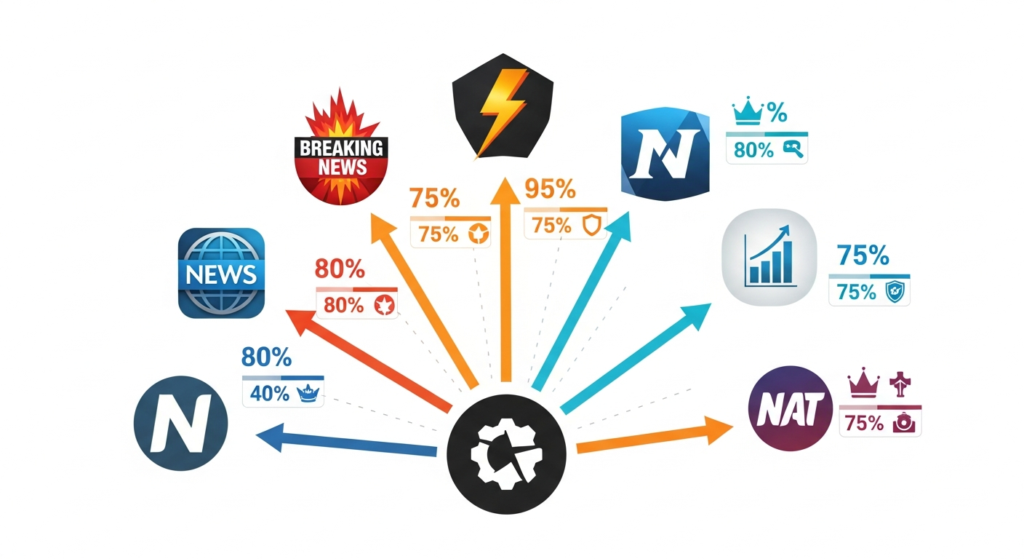
| Time Window | Status | Action Required |
| 0-4 Hours | 🔴 Critical | Draft & pitch immediately. Breaking news phase. Monitor and prepare rapid response. |
| 4-24 Hours | 🟡 Optimal | Pitch follow-up angles and expert analysis. Best window for journalist engagement. |
| 24-72 Hours | 🟢 Standard | Pitch “Second Day” stories, comprehensive guides, or contrarian takes. |
| 72+ Hours | ⚪ Archive | Too late for news cycle; pivot to evergreen content or wait for next opportunity. |
Best Practice: Monitor news continuously, prepare response within 2-4 hours of breaking story, and pitch journalists writing follow-up coverage.
Newsjacking Requirements
| Requirement | Description |
| Relevance | Your expertise must genuinely connect to the story |
| Speed | Response within hours, not days |
| Unique Angle | Add value beyond what’s already being said |
| Availability | Spokesperson ready for interviews |
| Prepared Assets | Data, quotes, or visuals ready to share |
⚠️ Newsjacking Ethics
Never attempt to newsjack:
- Tragedies or disasters (unless you’re providing direct aid/expertise)
- Controversial political events
- Stories where your connection is tenuous
- Situations where your pitch appears opportunistic
Poor newsjacking damages brand reputation and journalist relationships.
Reactive PR Topic Monitoring
Set up monitoring for:
| Monitor Type | Tools | Purpose |
| Industry Keywords | Google Alerts, Talkwalker | Catch breaking stories |
| Competitor Mentions | SearchAtlas, Mention | React to competitor coverage |
| Trend Topics | Google Trends, Twitter/X trending | Identify emerging stories |
| Journalist Beats | Twitter lists, newsletter subscriptions | Know what they’re covering |
Expert Positioning and HARO Alternatives
HARO (Help A Reporter Out) and Alternatives
HARO and similar platforms connect journalists with expert sources. While response rates are low, consistent effort yields steady link acquisition.
| Platform | Volume | Competition | Link Quality |
| Connectively (ex-HARO) | High | Very High | Medium-High |
| Qwoted | Medium | Medium | Medium-High |
| SourceBottle | Medium | Medium | Medium |
| ProfNet | Low | Low | High |
| #JournoRequest (Twitter/X) | Variable | Medium | Variable |
Expert Positioning Strategy
Step 1 Define Expertise Areas
- List 3-5 specific topics you can speak authoritatively on
- Identify intersection with journalist needs and current news cycles
- Prepare supporting credentials (experience, proprietary data, case studies)
Step 2 Build Response Templates
- Create modular quote templates for common topics
- Prepare data points and statistics ready to cite
- Draft biographical information in multiple lengths (1-sentence, 2-sentence, full bio)
Step 3 Monitor Opportunities
- Set up alerts for journalist queries (HARO, Qwoted, SourceBottle)
- Monitor social media for #JournoRequest hashtag
- Track publications in your niche for contributor opportunities
Step 4 Respond Quickly
- Target: Response within 1-2 hours of query
- Provide complete, quotable answers (2-3 sentences journalists can use directly)
- Include credentials and contact information
- Offer follow-up availability for deeper interviews
Step 5 Nurture Relationships
- Thank journalists who use your quotes
- Share and amplify published articles across your channels
- Proactively offer expertise for future stories
HARO Response Template
📧 HARO Response Template Copy and customize
Subject: Re: [Original Query Subject] — [Your Name], [Title]
Hi [Journalist Name],
[Direct answer to the query in 2-3 sentences. Make this quotable. Lead with your key insight.]
[Supporting context or data point — 1-2 sentences that add credibility]
[Additional insight that adds unique value — 1-2 sentences that differentiate you from other sources]
About [Name]: [Credentials in 2 sentences — title, company, years of experience, relevant expertise]
Happy to provide additional context, data, or a phone interview if helpful.
Best,
[Name]
[Title, Company]
[Phone] | [Email]
Digital PR Outreach Process
👥 Required Campaign Roles
The Strategist
Defines the Data Angle and Target Audience.
The Analyst
Mines Proprietary Data and validates Statistical Significance.
The Pitcher
Builds Media Relations and executes Email Outreach.
The Creative
Designs Infographics and Data Visualizations.
Building a Media List
Quality outreach starts with a targeted media list:
🎯 Tier 1: Primary Targets (20-30 contacts)
Highest priority, highest response potential
- Journalists who’ve covered your exact topic before
- Writers at top-tier publications in your industry
- Reporters you’ve already built relationships with
🥈 Tier 2: Secondary Targets (30-50 contacts)
Relevant but less direct connection
- Journalists covering adjacent topics
- Writers at mid-tier industry publications
- Contributors and freelancers in your space
🥉 Tier 3: Broad Targets (50-100 contacts)
Volume play for wider reach
- General business/tech reporters
- Regional publications
- Bloggers with strong domains (DR 40+)
📋 Data to Collect Per Contact
| Field | Purpose |
| Full Name | Personalization |
| Publication + Beat | Targeting relevance |
| Email (verified) | Direct outreach |
| Recent Articles (3-5) | Personalization hooks |
| Social Handles | Backup contact + research |
| Notes | Preferences, past interactions, response history |
The Perfect Pitch Formula
| Element | Purpose | Example |
| Subject Line | Get opened | “Data: Link building costs up 34% in 2026” |
| First Line | Show relevance | “I noticed your recent piece on SEO budgets…” |
| The Hook | Present the story | “We analyzed 50K outreach campaigns and found…” |
| Key Data | Provide substance | “3 headline findings: [bullet points]” |
| The Ask | Clear CTA | “Would this be useful for your readers?” |
| Assets | Make it easy | “Full study + infographics attached” |
Pitch Email Template
📧 Data Study Pitch Template Copy and customize
Subject: Data: [Surprising Finding] — [Study Name]
Hi [First Name],
[Personalized opening referencing their recent work — 1 sentence that shows you’ve read their articles]
[Company Name] just released our [Study Name] analyzing [data source/sample size]. A few findings I thought might interest you:
- [Finding 1] — [stat]
- [Finding 2] — [stat]
- [Finding 3] — [stat]
[One sentence on why this matters to their audience and fits their beat]
I’ve attached the full report and high-res graphics (embed codes included). Happy to provide additional data cuts, regional breakdowns, or expert commentary if useful.
Best,
[Name]
[Title]
Follow-Up Strategy
| Touchpoint | Timing | Approach |
| Initial Pitch | Day 0 | Full pitch with assets |
| Follow-Up 1 | Day 3-4 | Brief check-in, offer new angle |
| Follow-Up 2 | Day 7-8 | Share social proof (other coverage) |
| Final Touch | Day 14 | Close the loop, offer future resources |
⚠️ Follow-Up Best Practices
- Never more than 3 follow-ups per journalist
- Each follow-up should add value (new angle, new data, social proof)
- Respect “no” responses and unsubscribe requests
- Track everything in a CRM
Measuring Digital PR ROI and Success
🧪
Recommended Tool: Link Laboratory
Monitor DR changes, track link acquisition in real-time, and measure campaign ROI with automated reporting.
Primary Metrics
| Metric | How to Measure | Benchmark |
| Links Earned | Backlink monitoring tools | 5-50+ per campaign |
| Average Linking Domain DR | Ahrefs, Moz, Link Laboratory | DR 60+ for quality PR |
| Coverage Volume | Media monitoring | 10-100+ mentions |
| Referral Traffic | Google Analytics | Campaign-dependent |
| Brand Search Lift | Google Search Console, SearchAtlas | 10-30% post-campaign |
Secondary Metrics
| Metric | Significance |
| Social Shares | Amplification and reach |
| Journalist Response Rate | Pitch quality indicator |
| Coverage Sentiment | Brand perception impact |
| Keyword Ranking Changes | Direct SEO impact |
| Domain Authority Growth | Long-term authority building |
📊
Recommended Tool: SearchAtlas
Track brand mentions, monitor coverage sentiment, measure share of voice, and analyze AI corpus presence.
Digital PR ROI Calculation
💰 Costs (Investment)
| Cost Category | Typical Range |
| Content creation (research, writing, design) | $1,000-8,000 |
| Media database/tools | $200-500/month |
| Team time (research, outreach, follow-up) | $1,000-3,000 |
| Agency fees (if applicable) | $5,000-25,000 |
📈 Value (Returns)
| Value Component | Calculation |
| Link value | Links × Average DR × $50-200/link |
| Brand mention value | Mentions × Avg reach × $0.01-0.05 CPM |
| Traffic value | Referral sessions × Avg conversion value |
| Brand search lift | Δ branded queries × Organic CTR × Conversion value |
📊 ROI Formula
ROI = (Total Value – Total Cost) / Total Cost × 100
Example ROI Calculation:
| Metric | Value |
| Campaign cost | $5,000 |
| Links earned | 25 (avg DR 72) |
| Link value | 25 × $150 = $3,750 |
| Brand mentions | 45 |
| Mention value | $500 |
| Referral traffic | 2,000 sessions × $5 = $10,000 |
| Total value | $14,250 |
| ROI | ($14,250 – $5,000) / $5,000 = 185% |
Common Digital PR Mistakes
Mistake #1: Non-Newsworthy Content
| Wrong Approach | Right Approach |
| “Company X releases new feature” | “Study: 67% of users struggle with [problem]” |
| Generic industry overview | Original data with surprising findings |
| Self-promotional announcement | Story that helps journalist’s audience |
Mistake #2: Spray-and-Pray Outreach
| Wrong | Right |
| 500 journalists, same pitch | 50 journalists, customized pitches |
| Generic subject lines | Data-driven, specific hooks |
| No personalization | Reference recent work |
Mistake #3: Weak Visual Assets
| Wrong | Right |
| Text-heavy reports | Scannable infographics |
| Low-resolution images | Print-quality graphics |
| No embed codes | Easy-to-share assets |
Mistake #4: Poor Timing
| Wrong | Right |
| Launching during major news events | Monitoring news cycle for clear windows |
| Friday afternoon pitches | Tuesday-Thursday mornings |
| Holiday week launches | Avoiding low-coverage periods |
Mistake #5: No Relationship Building
| Wrong | Right |
| Pitch once, never follow up | Nurture journalist relationships |
| Only reach out when you need coverage | Provide value between campaigns |
| Ignore published coverage | Thank and amplify journalists |
Frequently Asked Questions
How much does digital PR link building cost?
Digital PR campaigns typically cost between $3,000 and $15,000 per month depending on agency tier and asset complexity. Here’s the breakdown:
- In-house: $2,000-10,000 per campaign (team time + tools)
- Agency: $5,000-25,000+ per campaign
- Cost per link: $100-500 for quality DR 70+ editorial links
ROI typically exceeds traditional link building due to higher link quality.
How long does a digital PR campaign take?
A standard Digital PR campaign requires 6 to 12 weeks from ideation to initial link acquisition. Here’s the typical breakdown:
- Research and content creation: 2-4 weeks
- Outreach and coverage: 2-4 weeks
- Secondary wave and measurement: 2-4 weeks
Newsjacking and reactive PR can happen within hours.
How many links can I expect from a digital PR campaign?
Variable based on content quality and outreach:
- Strong data study: 15-50+ links
- Survey/research: 10-30 links
- Expert commentary: 1-5 links per placement
- Reactive PR: 2-10 links per story
Quality (DR, relevance) matters more than quantity.
Do I need an agency for digital PR?
No, you do not strictly need an agency, provided you have internal resources for data analysis, design, and media relations. In-house teams can succeed with:
- Dedicated time for research and outreach
- Access to media databases
- Content creation capabilities
- Relationship-building commitment
Agencies provide expertise, journalist relationships, and scalability.
What’s the difference between digital PR and traditional PR?
Digital PR specifically targets link acquisition alongside coverage:
- Traditional PR measures impressions, reach, sentiment
- Digital PR measures links, referring domains, SEO impact
- Digital PR requires SEO knowledge + PR skills
How do I find journalist contacts?
Use multiple approaches:
- Media databases (Muck Rack, Cision, Prowly)
- Publication mastheads and bylines
- Twitter/X bio links and #JournoRequest
- LinkedIn searches
- Google “journalist + topic + contact”
Verify emails before sending.
What makes content “newsworthy”?
Content is newsworthy when it has:
- Timeliness: Connects to current events or trends
- Impact: Affects a significant audience
- Novelty: Reveals something new or surprising
- Conflict: Challenges assumptions or creates debate
- Human interest: Emotional resonance
Data that proves or disproves common beliefs is particularly effective.
How do I measure digital PR success?
Track these KPIs:
- Links earned (volume and quality)
- Linking domain DR average
- Brand mention volume
- Referral traffic
- Brand search volume changes
- Ranking improvements for target keywords
Link Laboratory and SearchAtlas provide comprehensive tracking.
Digital PR Glossary
🧩 Key Entity Relationships
| Subject (Entity) | Predicate (Relationship) | Object (Entity/Concept) |
| Digital PR | increases | Domain Authority (DR) |
| Journalists | provide | Editorial Backlinks |
| Data Studies | generate | Newsworthy Angles |
| Newsjacking | leverages | Breaking News Cycles |
Digital PR
A link building strategy that uses public relations tactics to earn editorial backlinks from news sites and authoritative publications.
Data Study
Original research or analysis presented as newsworthy content to attract journalist coverage and backlinks.
Newsjacking
Inserting your brand into breaking news by providing expert commentary, data, or unique perspective to journalists covering the story.
Reactive PR
Responding to journalist queries (HARO, Qwoted) or trending topics with expert commentary to earn coverage and links.
Media List
A targeted database of journalists, their beats, contact information, and notes for personalized outreach.
Pitch
An email to a journalist proposing a story idea or offering expert commentary/data for their coverage.
Embargo
An agreement with journalists to receive early access to information with a promise not to publish until a specified date/time.
Exclusive
Offering a story or data to one publication first, in exchange for priority coverage.
Earned Media
Coverage obtained through editorial merit rather than paid placement. Digital PR focuses on earning editorial links.
Referring Domain
A unique domain that links to your website. Digital PR aims to increase referring domains from high-DR sources.
Key Takeaways: Digital PR Link Building in 2026
- Digital PR targets the top of the authority hierarchy — News and media links carry disproportionate SEO weight
- Data studies deliver highest ROI — Original research positions you as a primary source
- Speed wins in reactive PR — Newsjacking requires response within hours, not days
- Quality outreach beats volume — 50 personalized pitches outperform 500 generic emails
- Visual assets are essential — Journalists need ready-to-use graphics and embed codes
- Relationships compound over time — Today’s contact becomes tomorrow’s coverage
- Measure beyond links — Track brand mentions, search lift, and AI corpus presence
- Monitor and iterate — Use Link Laboratory for link tracking and SearchAtlas for brand intelligence
Ready to build authority through digital PR?